
What comes before painting Values?
If you want to paint realistic faces

Dear artists,
Welcome to the #2 letter of my Diary!🌟
Do you struggle with making your painted faces look more realistic?
Do you also struggle with making your painted faces look more interesting?
If yes, this chapter is for you, where I’ll share tips on giving VOLUME and SATURATION to your painted faces. This is from week 2 of CGMA Digital Portrait Painting by Mélanie Delon.
COMPOSITION
Wk 2 Goal: How to frame the portrait to tell the story better?
Always think about what you want to STORYTELL, and what feeling you want to portray?
Every element in the piece (background, costume, props, etc) should help us understand the character better, and not just because it’s pretty
The focus should still be on the face since it’s a portrait painting. Keep empty spaces around the face to frame it
That’s why at the start, it’s important to craft a persona for your character. This will guide the direction for the elements you want to put later.
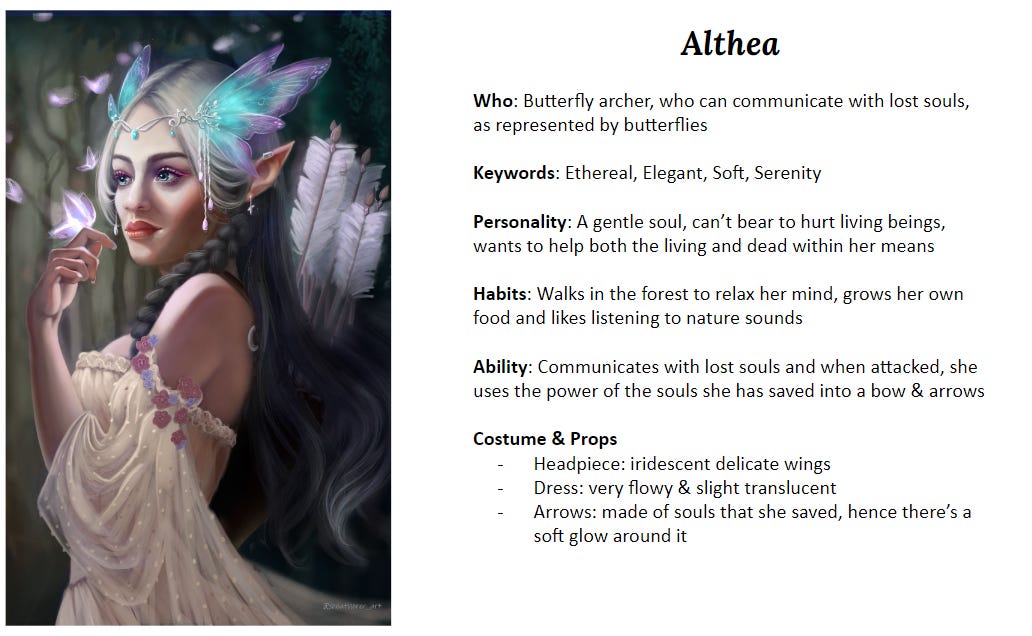
Placement: Honestly no right composition, it depends on what you want to story-tell. Always ask if the intended focal point is clear enough from the thumbnail
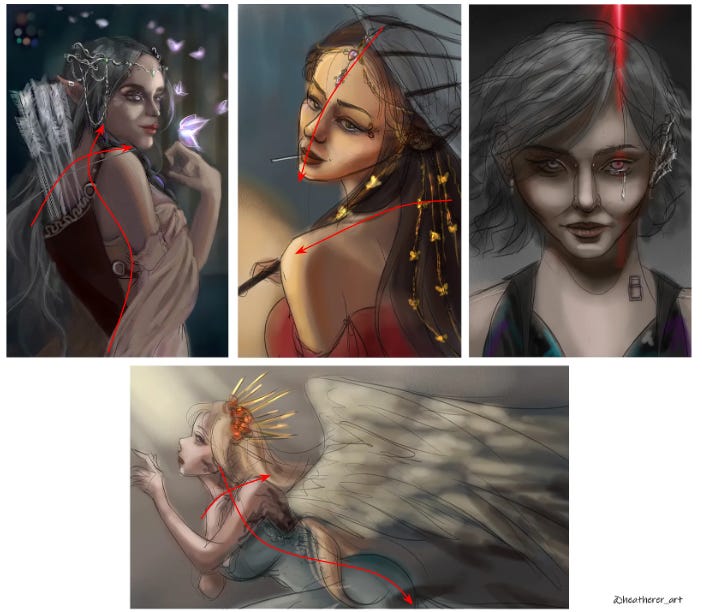
Try to have a slight tilt in body and/or face to feel more dynamic, unless it’s a full front headshot, which can look dynamic since it’s very near
Mélanie strongly recommends this in order of importance: (1) Face Structure, (2) Volume, (3) Shapes
I’ve asked about using Asaro head references, but she advised NOT to use at the start as they focus on the light & shadow, instead of the structure
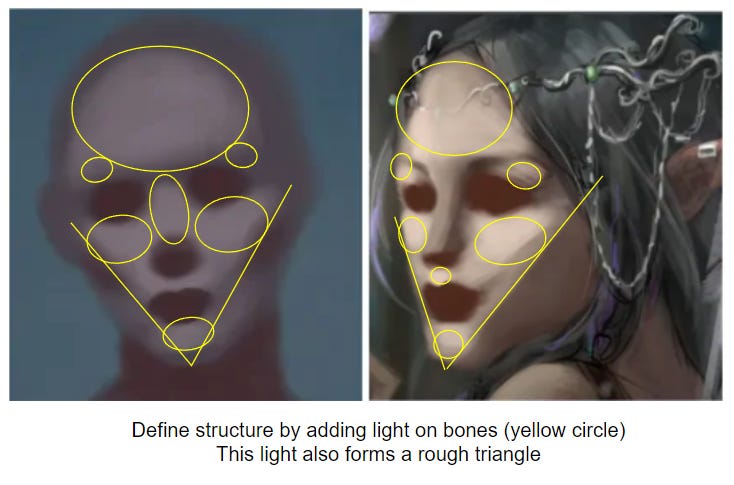
Face Structure is important first as that’s the underlying foundation, then it’s easier to place the lights & shadows AFTER
Define structure by adding light on bones (eg. browbone, under brow on the outer area, cheek, philtrum & chin. This forms a rough triangle
Volume is seen with Lights, so be patient to add multiple layers - each layer with more brightness, more variation in color and brush strokes, using a big brush with soft pen pressure
Assignment: Submit 3 more colored thumbnails, with different color schemes and body positioning. My storytelling themes are ‘warm sunset’, ‘sadness’, and ‘hope’.
Key Feedback from Mélanie:
OVERALL
Focus on defining Face Structure first, as shared above
Be brave to add more saturation to Shadows - better to have more than none, as skin is translucent and can see the blood through the skin, so need to feel the red tone underneath
Give a lot of saturation to eye sockets, nose bottom and lips first
Shadows around the nose & ears are redder, as the skin there is very thin and light goes through them more
Nose bridge shadows should be subtle & suggestive. This keeps viewers focused on more important facial features like eyes
INDIVIDUAL FEEDBACK
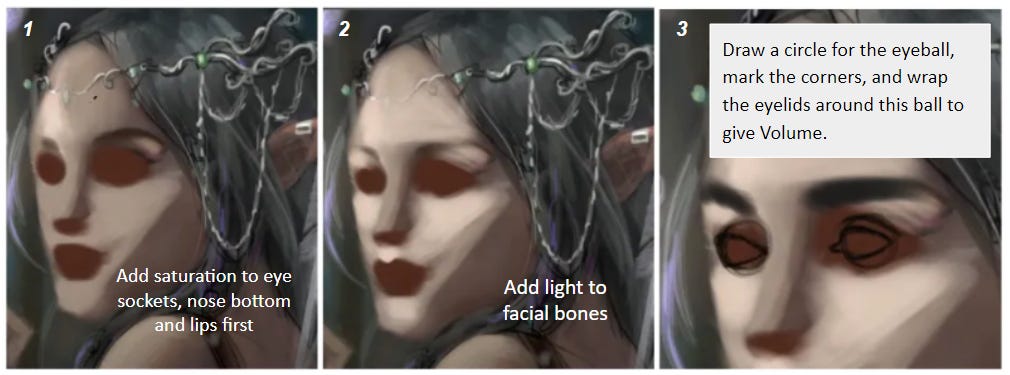
^ Archer: Eyeball Structure - Draw a circle for the eyeball, mark the corners, and wrap the eyelids around this ball to give Volume. Then add the pupil and iris.
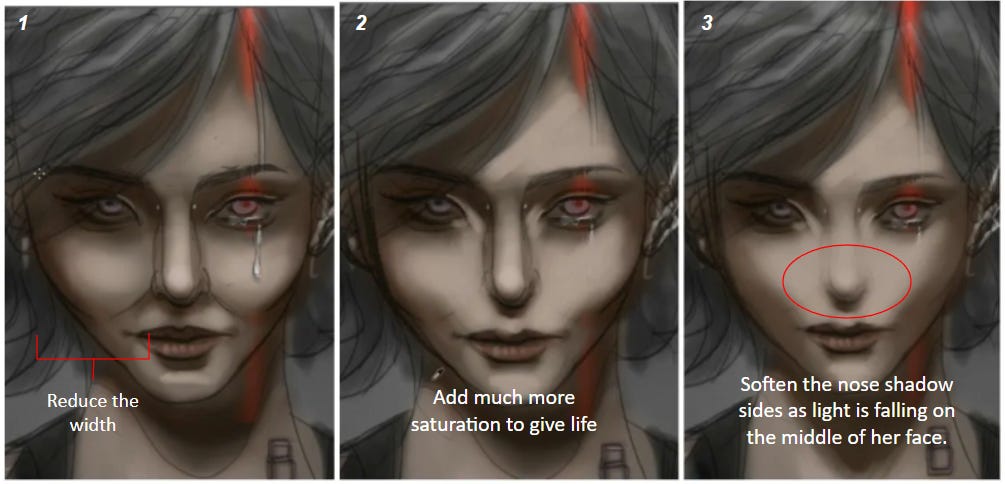
^ Robot: The left side (facing us) looks pretty big so reduce the width. Add much more saturation to give life, and soften the nose shadow sides as light is falling on the middle of her face.
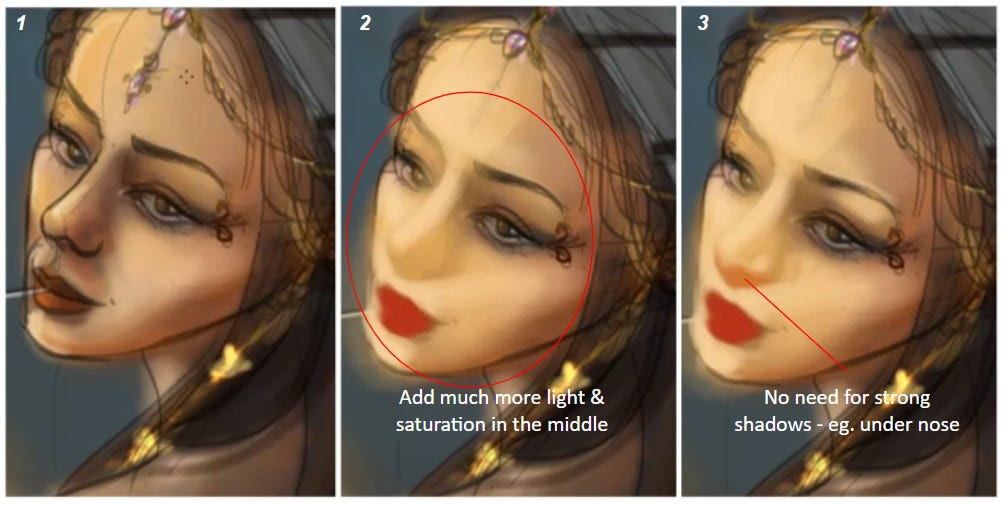
^ Sunset: In very strong light, light & shadows are very colorful, vibrant & intense. Add much more light & saturation in the middle, and no need for strong shadows at all
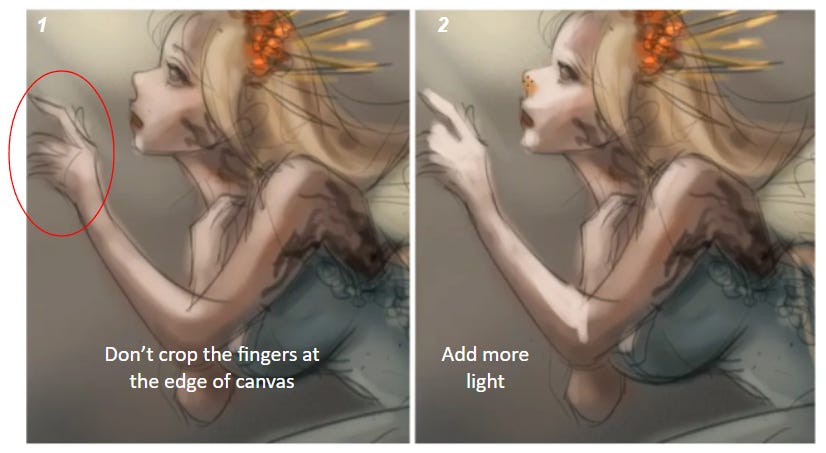
^ Angel: Composition mistake - don’t crop the fingers
SUMMARY
Main takeaway: Push light on face bones, very subtle shadows around the nose, more saturation for shadows.
I’ve also created a summary sheet of the key learnings & process steps for my CGMA portraits, which you can download for free here.
Other Highlights of My Week
Had delicious Pho with my dear friends
I’ve resumed my lessons on ‘Painting with Light & Color with Tonko House’ on Schoolism. Here’s one of the studies I’ve done, and I’m pretty proud of it.
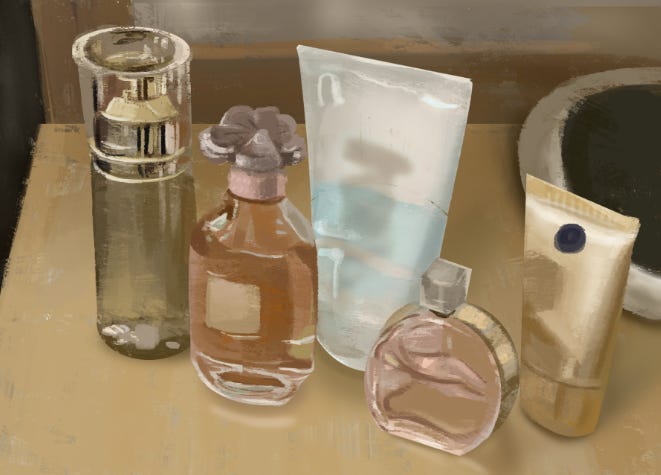
Glass: reflects light lightly on the table, and has pretty dark & light outlines near the top & bottom
Metal: Strong contrast between light & dark
Plastic: Highlights can get pretty strong, but not shadows. The transition from light to shadow is pretty gradual too
What did you think of this Diary?
Is it useful? Too long? Easy to digest?
Feel free to reply to this email if you have any feedback or any questions!
I’ll be dropping the next letter on the coming Sunday, sharing week 3 of my CGMA journey, so stay tuned.
Have a lovely week everyone!🖤